When it comes to organizing a lakehouse, the Medallion architecture has become the market standard in Databricks. It solves a classic problem: how to transform raw, messy data into reliable business information in a scalable and traceable way. I will explain the three layers with a practical example.
What is Medallion architecture?
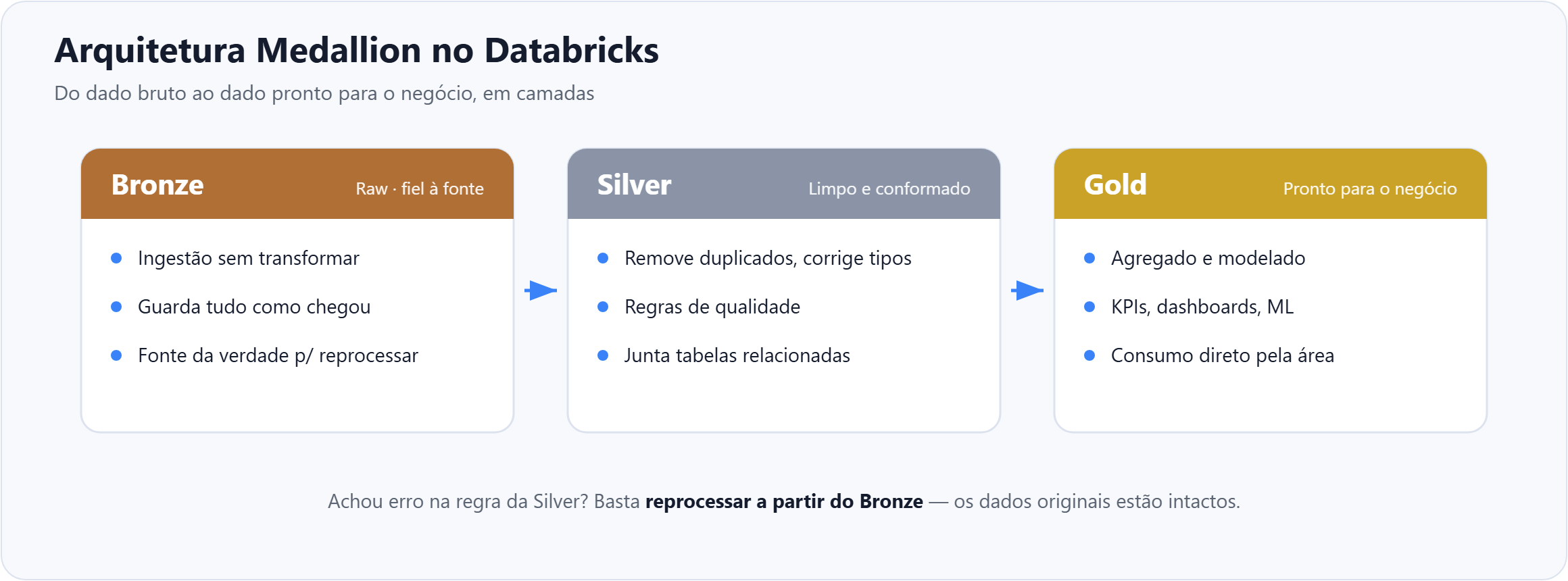
It is a data-organization pattern with three layers of increasing quality — Bronze, Silver, and Gold — each refining the data a little further. The name comes from the idea of “medals”: the higher the layer, the more valuable and reliable the data.
The three layers
🥉 Bronze — raw data
Faithful ingestion from the source, without transformation. It stores everything as it arrived (including errors), with metadata about when and where it came from. It serves as the “source of truth” for reprocessing when needed.
🥈 Silver — clean and conformed data
Here you clean, validate, and standardize: remove duplicates, fix data types, apply quality rules, and join related tables. The data becomes “usable” for exploratory analysis and for feeding the Gold layer.
🥇 Gold — business-ready data
Aggregated and modeled tables for direct consumption: dashboards, KPIs, machine learning. This is the data the business area actually uses.
Practical example: store sales
- Bronze: sales CSV files arrive every hour from several stores and are written as Delta tables, exactly as they came in.
- Silver: a job brings all stores together, converts dates, removes duplicate orders, and discards rows without value — generating a single clean
vendastable. - Gold: another job aggregates by day/store/product, calculates revenue and average ticket, and writes the
vendas_diariastable that feeds the executive dashboard.
If tomorrow you discover an error in the Silver rule, just reprocess from Bronze — the original data is intact.
Why this matters
- Traceability: you know where each number came from.
- Incremental quality: problems are isolated by layer.
- Safe reprocessing: Bronze is the safety net.
- Scale: Delta Lake provides ACID transactions and performance even at high volume.
2026 update The Bronze→Silver→Gold concept has not changed, but the tooling has evolved: Unity Catalog brings end-to-end governance and lineage, Delta liquid clustering replaces manual partitioning with automatic optimization, and Delta UniForm makes your Gold tables readable as Apache Iceberg as well — without duplicating data.
Frequently Asked Questions (FAQ)
Do I always need all three layers?
In most cases, yes — but the size of each one varies. Simple projects may have a lean Silver layer; the important thing is to separate raw data, clean data, and business-ready data.
Is Medallion exclusive to Databricks?
No. It is an architecture pattern — you can apply it in Microsoft Fabric, Synapse, or any lakehouse. Databricks simply popularized it with Delta Lake.
What is the difference between Medallion and a traditional Data Warehouse?
Medallion lives on top of a lakehouse (files + Delta), combining data lake flexibility with transactional reliability. A classic DW is more rigid and expensive for semi-structured data.
Conclusion
Medallion architecture is not about trendy technology — it is about data discipline. Bronze stores, Silver cleans, Gold delivers value. Simple to understand and powerful in practice.
👉 I explain this in detail in my book “Databricks from zero to advanced” and in videos on the channel.